
One of the most common — and most expensive — mistakes after a water event is assuming a wall is fine because it looks fine. Paint, drywall, and insulation can mask moisture sitting inside a wall cavity for weeks, quietly setting up conditions for mold and structural damage. Finding that moisture isn't guesswork; it's a specific process with specific tools.
Why Walls Hide Moisture So Well
A painted drywall surface can dry to the touch within hours even while the wall cavity itself stays wet much longer. Water also travels — it wicks upward through drywall and framing, moves sideways along top and bottom plates, and pools in places you'd never guess, like inside an exterior wall behind brick veneer. Without checking, there's no way to know from a visual inspection alone whether a wall is actually dry.
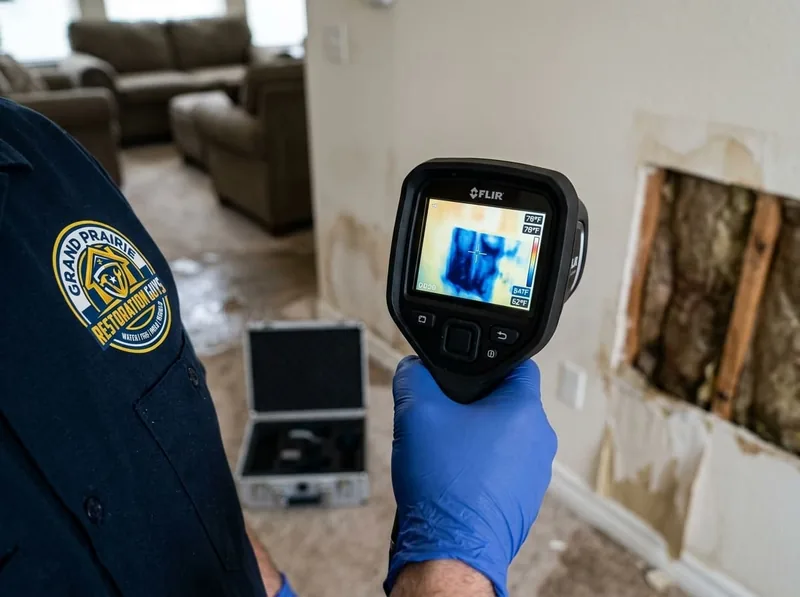
The Tools Professionals Actually Use
Moisture Meters: Pin and Pinless
A pin-type meter uses two small probes pressed into the material to measure electrical resistance, which correlates to moisture content — accurate, but it leaves tiny holes, so it's used at a few reference points. A non-invasive (pinless) meter scans a surface without penetrating it, so it's often used first to map a broader area before pinpointing spots with a pin meter.
Thermal Cameras Guide, They Don't Confirm
Thermal cameras detect surface temperature differences, not moisture directly. A cooler patch can indicate evaporative cooling from moisture, but it can also just be an insulation gap or a draft — which is why thermal imaging guides where to check with a moisture meter, not standalone proof of a wet wall.
How a Moisture Map Actually Gets Built
The process starts with a reference reading from an unaffected area of the same material, establishing what "normal" looks like, since building materials naturally hold some baseline moisture. From there, readings are taken systematically in a grid pattern, working outward from the known source until readings return to baseline on all sides. This is how the actual extent of a hidden moisture problem gets defined.
Common Hiding Spots in North Texas Homes
A few locations come up repeatedly here:
- Where a wall meets the slab — North Texas's expansive clay soil can stress slabs and the supply lines running through them, producing slow leaks that show up as moisture along a baseboard rather than an obvious puddle
- Behind exterior wall cladding after wind-driven rain
- In older Grand Prairie homes with pier-and-beam construction, where moisture at the crawl space level can wick into interior wall cavities from below
What Happens After Hidden Moisture Is Found
If the wall cavity is accessible and the moisture level isn't extreme, drying in place with air movers, dehumidification, and sometimes small "weep" holes is often possible without opening up the wall. If moisture is extensive, long-standing, or involves saturated insulation, opening the wall is usually the more reliable path. Either way, the decision is based on actual readings — see can wet drywall be saved.
Why This Step Gets Skipped — and Why That's Costly
It's tempting to consider a job finished once visible water is gone and surfaces feel dry, but skipping moisture mapping is how a straightforward water event turns into a mold problem weeks later. A wall that tests dry is genuinely different from one that just looks dry.
What This Looks Like in Practice
A Typical Scenario
A kitchen sink line leaks slowly before anyone notices a slightly soft feel at the base of an adjacent wall — a small, contained problem on the surface. Once a technician takes a reference reading elsewhere in the kitchen and works outward, it's common to find moisture has actually traveled a foot or more inside the cavity, well beyond where the wall feels soft.
Without that mapping step, the instinct is to patch the small visible section and repaint over it, leaving the wider wet area inside the wall to keep supporting mold growth out of sight.
Questions Worth Asking Before Work Starts
Reasonable questions for a contractor assessing a suspected moisture issue:
- What reference reading established a normal baseline for this material?
- How far did the moisture mapping extend beyond the visibly affected area?
- Is the plan to dry in place or open the wall — and why?
A specific answer to each is a good sign the assessment was done properly.
Exterior Walls Add an Extra Layer of Complexity
Why Exterior Assemblies Are Harder to Read
An exterior wall isn't just drywall and framing — it includes sheathing, a weather barrier, siding or masonry veneer, and insulation, stacked together. Moisture from a roof leak, wind-driven rain, or a failed window seal can sit between layers in a way that's hard to detect from either surface alone, which is part of why an exterior-wall problem sometimes takes longer to diagnose.
Interior Walls Follow the Same Approach
Interior walls are simpler to assess since there's no weather barrier involved, but they're not exempt — a plumbing leak or an upstairs overflow gets the same mapping approach. Readings on an active drying job are typically repeated daily until every affected zone reaches a stable baseline.
Frequently Asked Questions
Can I check for hidden moisture myself with a hardware-store moisture meter?
A basic pinless meter can give you a rough indication, but without a proper reference reading and systematic mapping, it's easy to misinterpret the result. It's a reasonable first check, not a substitute for a professional assessment if you're unsure.
Does thermal imaging prove there's water in a wall?
Not by itself — thermal cameras show temperature differences, which can be caused by moisture, but also by insulation gaps, drafts, or even different framing materials. It's a tool for guiding where to check, always paired with a moisture meter reading.
How long can moisture stay hidden in a wall before it's a real problem?
It varies with material and conditions, but hidden moisture that's gone unaddressed for more than about a week, especially in a humid climate, is a reasonable trigger for concern about mold developing inside the cavity even before it's visible.
Do I need to open the wall to know for sure?
Not always — moisture meters can often confirm a cavity is dry or wet without opening anything. Opening the wall becomes necessary mainly when readings show a problem that needs to be physically addressed, like removing saturated insulation.
Is this only relevant after an obvious leak, or can it happen with no clear cause?
It can happen without an obvious trigger — a slow slab leak or a small roof intrusion can go unnoticed for a long time before a musty smell or a subtle stain gives it away, which is exactly when a moisture assessment is most valuable.
Do interior walls need the same kind of check as exterior walls?
Usually less often, since interior walls aren't exposed to weather, but they're not exempt — a plumbing leak, an upstairs bathroom overflow, or water from an adjacent exterior wall can all reach an interior wall cavity, so the same moisture-mapping approach applies whenever there's a reason to suspect it.