
Irving has a split personality that most North Texas cities don't: it's home to one of the largest master-planned business districts in the country, with corporate office towers and high-rise residential buildings clustered around a canal-side urban core, and it's also a city of established single-family neighborhoods that predate all of that by decades. A significant share of Dallas Fort Worth International Airport sits inside Irving's city limits too, which means a lot of Irving's built environment — hotels, office parks, logistics buildings — exists specifically because of that proximity.
Water damage in a building like that isn't the same problem as water damage in a single-family house, and the response has to account for the difference. Whether it's a burst supply line on the 14th floor of an office tower, a sprinkler head that discharged by mistake, or a slab leak in an older Irving neighborhood, calling (817) 618-7675 puts you in touch with a crew that treats those as genuinely different jobs, not the same job at a different address.
A safety note while help is on the way: never approach standing water near an electrical panel, server room, or plugged-in equipment, and treat any sprinkler discharge or building mechanical failure as a job for facilities staff and responding technicians, not a do-it-yourself fix. In a high-rise, leave elevator and stairwell water on stairs to professionals as well — it's a slip hazard that's easy to underestimate.
Water Damage Restoration in Irving, TX
Tracing Water Through a Building
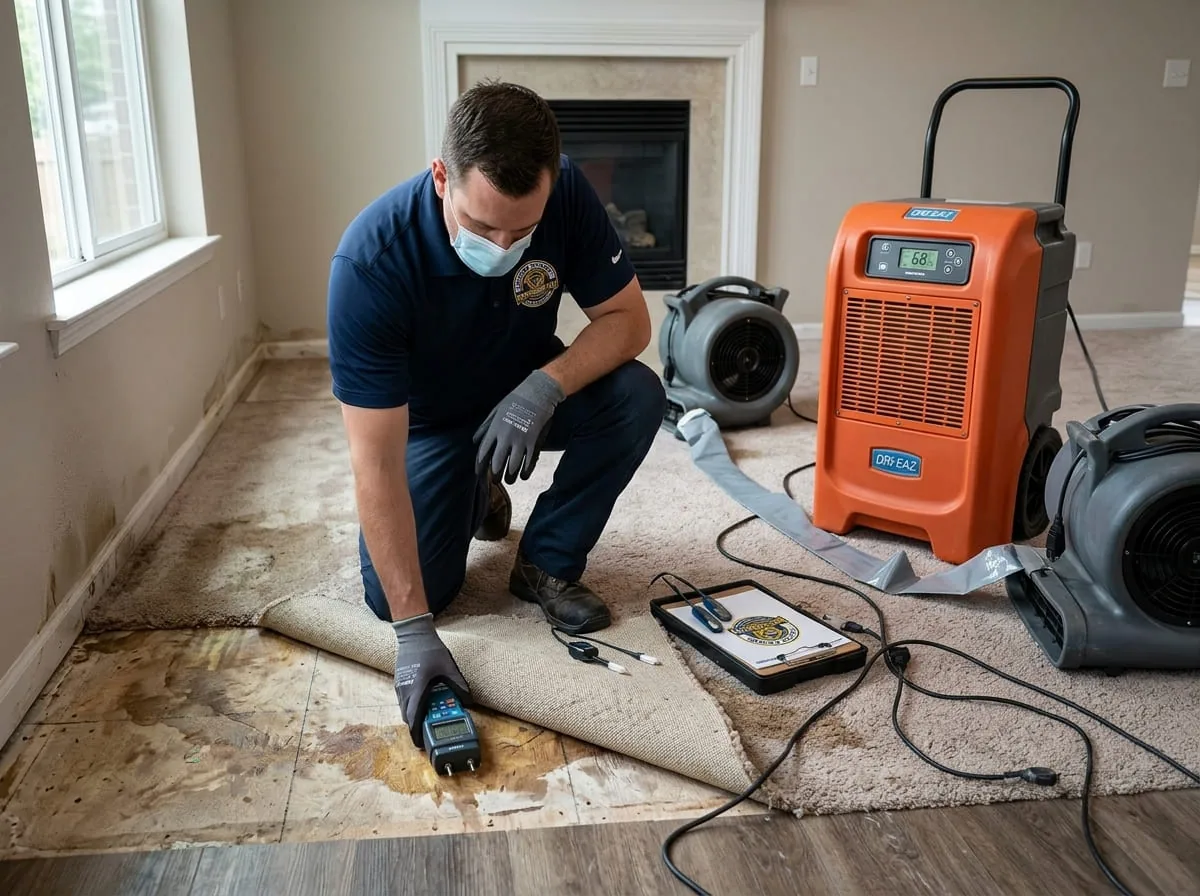
Water damage restoration in a high-rise or corporate campus setting starts with a question that doesn't come up in a typical single-family job: how many floors, units, or tenants are affected below the source, not just at it. Water moving down through a building follows electrical conduit, plumbing chases, and floor penetrations, so an assessment in a multi-story Irving property has to trace that path before extraction and drying equipment even get set up.
Commercial vs. Residential Drying
For that reason, structural drying and dehumidification in these buildings often means specialized equipment sized for large open floor plates and ceiling plenum spaces, not just a residential-scale air mover. On the residential side of Irving, the work looks more familiar: water extraction, burst pipe response, and drying for single-family homes and townhomes in Irving's longer-established neighborhoods away from the business district.
Why Documentation Carries More Weight
Documentation also carries more weight in Irving than it does in a lot of purely residential markets. A commercial water loss in a leased office or hotel typically involves a property manager, a tenant, and sometimes a separate building engineer, all of whom need a clear record of what happened, when extraction started, and what moisture readings looked like at each stage. That paper trail matters just as much as the physical drying work when it comes time to settle a claim or resolve a lease dispute over responsibility for the damage.
Irving's Growth: From Rail Town to Corporate Hub
From Suburb to Business Hub
Irving grew as a fairly typical Dallas-area suburb through the mid-20th century, with residential development expanding through the 1950s and '60s as Dallas itself grew outward. What set Irving apart from many of its neighbors was the decision, starting in the 1970s, to build a large master-planned mixed-use business district on undeveloped land in the city — a development that grew over the following decades into a dense cluster of office towers, hotels, and canal-side high-rise residences unlike almost anything else in this part of North Texas.
A Wider Range of Building Types
That means Irving's building stock spans a wider range than most cities its size: older single-family homes from the city's original mid-century growth, garden-style apartment complexes built through the '70s and '80s, and, closer to the business district, a genuinely urban mix of high-rise office and residential towers built from the 1980s through today. Each of those building types carries different water-damage risk — older homes carry the same slab-and-clay-soil risk as the rest of North Texas, while the newer high-rise stock introduces risks tied to complex plumbing systems, fire sprinkler networks, and shared mechanical rooms.
A Uniquely Dense Business District
The business district itself sits on flat land along a constructed canal system, a defining visual feature of that part of Irving and part of why the district reads as more of a walkable urban village than a typical office park. That density of buildings close together, several of them high-rise, is genuinely uncommon for this part of North Texas outside of downtown Dallas or Fort Worth, and it's a big part of why Irving's commercial water-damage risk profile looks different from a lower-density suburb nearby.
Common Water Damage Scenarios We See in Irving
Irving's mixed building stock produces a wider range of common water-damage calls than most single-character cities:
Typical Causes We See
- High-rise and office-tower leaks — a failed supply line, HVAC condensate overflow, or accidental sprinkler discharge affecting one or more floors below the source.
- Slab leaks in Irving's older single-family neighborhoods, driven by the same expansive clay soil movement documented across North Texas.
- Poly-B plumbing failures in homes and garden-style apartment buildings built roughly 1978–1995.
- Flat-terrain flash flooding during intense storms, a documented regional pattern across the Metroplex, including areas near the business district and canal-side development.
- Hotel and hospitality water events, given Irving's dense concentration of hotel properties tied to the airport and business travel.
- Appliance and water heater failures in both single-family homes and multi-unit residential buildings.
- Shared mechanical room and rooftop equipment leaks, a building-specific risk in office towers and larger multifamily properties that doesn't have a real equivalent in single-family housing.
Residential and Commercial Water Damage Response
Residential Response
Residential water damage restoration covers Irving's single-family neighborhoods and garden-style apartment communities with the same extraction-and-drying approach used across the rest of our North Texas service area.
Commercial Response
Commercial water damage restoration carries extra weight in Irving specifically because of the concentration of corporate office space, hotels, and high-rise buildings tied to the business district and the airport. A water event in a leased office suite or a hotel isn't just a property problem, it's often a tenant-relations and business-continuity problem, and crews responding to commercial losses in Irving work with that pressure in mind — fast extraction, clear documentation for property management and insurers, and drying verified with equipment, not guesswork.
Why Commercial Jobs Move Faster
For a hotel property specifically, an out-of-service floor or wing has an immediate, quantifiable revenue impact, and corporate guests and event bookings don't wait for a slow repair timeline. That's part of why commercial response in Irving tends to move on a compressed schedule compared to a similar-sized residential loss — not because the drying science is different, but because the cost of downtime is higher and more visible.
Fire Damage Restoration in Irving, TX
Fire and Water Together
Fire damage restoration in Irving follows the same split as water damage: standard residential smoke, soot, and odor cleanup in established neighborhoods, and a heavier commercial fire damage restoration workload tied to the office towers and hotels near the business district. After any fire, contents cleaning and pack-out is often part of the job, particularly in high-rise residential units where contents need to be moved out to allow drying and repair work to proceed.
Smoke Travels Through HVAC
In an office tower, smoke and soot damage rarely stay contained to the floor where a fire started — HVAC systems can carry smoke odor to floors above and below, which means an assessment often needs to check further than the visibly damaged suite. Where structural repair is needed after a fire, the fire damage repairs and reconstruction page covers what that process involves.
Mold Remediation in Irving, TX
Hidden Leaks in Shared Buildings
Hidden water intrusion is a particular concern in Irving's high-rise and multi-tenant buildings, where a slow leak inside a wall cavity or above a drop ceiling can go unnoticed for a long stretch before anyone traces it back. Combined with North Texas's hot, humid summers — which shrink the window before mold becomes a realistic concern compared to a drier climate — that makes mold after water damage a genuinely important service in Irving, for both single-family homes and commercial mold remediation in office and hospitality buildings. Mold remediation crews serving Irving are equipped to work in both settings.
Air Quality as a Warning Sign
Air quality complaints in a shared office building are also worth taking seriously as a possible sign of hidden mold. Musty odor near a specific vent, a stuffy conference room, or an unexplained increase in tenant complaints about air quality can point to moisture trapped somewhere in a ceiling plenum or mechanical space that a visual walkthrough alone won't catch.
The Restoration Process, Step by Step
The sequence stays consistent whether the job is a house or a high-rise floor, though the scale and equipment differ:
- Call and dispatch — (817) 618-7675, answered 24/7, with a crew dispatched based on what you describe.
- Assessment — in multi-story buildings, this includes tracing water travel through floor penetrations and shared mechanical spaces, not just the room where it's visible.
- Extraction — standing water and saturated material removed with equipment sized to the space, residential or commercial.
- Drying and dehumidification — monitored to a genuine dry standard, verified with moisture readings rather than visual inspection alone.
- Cleaning and sanitizing — particularly important in shared or tenant-occupied buildings.
- Repairs or reconstruction — handled, where needed, by a contractor holding a general contractor licence, from initial extraction through full reconstruction and repairs.
Keeping Everyone Informed
In a multi-tenant building, one more step usually runs in parallel with all of the above: keeping property management and any affected tenants informed as the job progresses. Clear, regular updates on drying timelines and moisture readings make it easier for a building owner to plan around the disruption instead of being caught off guard by it.
Serving Irving and Nearby Communities
Response covers all of Irving and reaches into neighboring cities as well, including Arlington to the south along the Grand Prairie corridor, and Euless and Grapevine to the north near DFW Airport.
That coverage area lines up well with how people and businesses in this part of the Metroplex actually move — a corporate tenant with offices in Irving and a warehouse near the airport in Euless doesn't need two different vendors for two different addresses.
Frequently Asked Questions
Do you handle water damage in office towers and high-rise buildings near Las Colinas?
Yes. Commercial and high-rise water damage response is a significant part of the work in Irving, including tracing water travel through multiple floors and coordinating with property management.
What should a business do first after discovering water damage in a leased office?
Shut off the water source if it's safe and accessible, notify building management, and call (817) 618-7675 so extraction can start before the water spreads further into flooring, walls, or the floor below.
Are older Irving neighborhoods still at risk for slab leaks?
Yes — the same expansive clay soil that affects the rest of North Texas runs under Irving's older single-family neighborhoods, and slab leaks from soil-driven pipe stress are a recognized, common cause of water damage there.
Does proximity to DFW Airport affect the type of water damage calls you see in Irving?
It contributes to a higher share of hotel and commercial property calls, given the concentration of hospitality and office buildings serving air travelers and business tenants near the airport.
Can a water leak in a high-rise cause mold in units that weren't directly flooded?
It can. Water traveling through shared walls, floor penetrations, or ceiling plenum spaces can introduce moisture into adjacent units, which is why a full moisture assessment matters even when visible damage looks contained to one area.
Do you coordinate directly with property management companies?
Yes. Commercial and multifamily losses in Irving routinely involve a property manager or building engineer, and keeping that contact informed throughout the assessment, extraction, and drying process is a standard part of the response.