

Lancaster sits in southern Dallas County along the I-35E corridor, with a historic town square anchoring an older residential core surrounded by decades of later suburban growth. That range of housing ages means water damage calls here come from a genuinely wide mix of causes — aging plumbing and sewer lines in the older sections, and the region's usual clay-soil and storm risks nearly everywhere else.
Older Sewer and Drain Lines Are Worth Watching
Homes in Lancaster's older neighborhoods can have sewer and drain lines that have simply had more decades to develop cracks, root intrusion, or partial blockages than a newer subdivision's plumbing. A sewage backup is a different category of water damage entirely — it involves contaminated water and requires containment and disinfection procedures beyond standard extraction, and it should never be handled without protective equipment and professional cleanup.
Slab Movement Affects the Newer Neighborhoods
Newer, slab-foundation homes in Lancaster face the same expansive clay soil issue as the rest of North Texas — seasonal ground movement stressing supply lines under the slab until one eventually gives out. These slab leaks tend to be quieter than a sewage backup: a warm patch on the floor, unexplained carpet dampness, or a rising water bill are usually the first sign.
Getting a Structure Dry Again
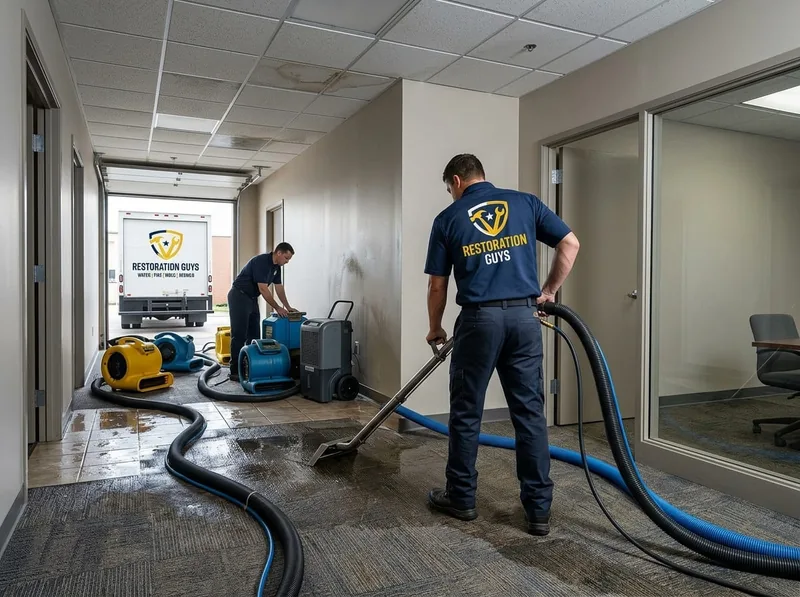
Regardless of the source, the process centers on extraction, structural drying and dehumidification, and moisture tracking until materials are confirmed dry rather than just surface-dry. From initial extraction through full reconstruction and repairs, the contractor on the job holds a general contractor licence, which matters especially after a sewage event where affected drywall or flooring often needs to be replaced rather than dried in place.
If You Suspect a Sewage Backup
A sewage backup calls for more caution than an ordinary water leak, since the water itself is contaminated:
- Keep everyone, especially kids and pets, out of the affected area entirely.
- Don't attempt to clean up sewage water yourself or use a household wet vacuum on it.
- Avoid touching contaminated surfaces without gloves if contact is unavoidable before help arrives.
- Ventilate the area if possible by opening a window, without walking directly through the affected space.
Commercial properties near Lancaster's downtown handle these same sewage and plumbing concerns, and commercial water damage restoration follows the same containment-first approach used in homes, adjusted for the size of the space.
Fire Damage in Lancaster
Fire damage calls in Lancaster range from older-home electrical faults to newer-home kitchen accidents. The fire damage restoration hub covers smoke odor removal, soot cleanup and reconstruction across the city.
Mold Risk, Especially After a Crawl Space or Sewage Event
Some of Lancaster's older homes near downtown include pier-and-beam construction with a crawl space rather than a slab, which — like a sewage backup — creates a hidden area where moisture and contamination can sit. Combined with hot, humid Texas summers, that's a real setup for mold. See mold after water damage for what to watch for.
Nearby Ellis County / I-35E Coverage
Lancaster is covered alongside Red Oak, Waxahachie and Midlothian along the same I-35E corridor.
Frequently Asked Questions
Is a sewage backup dangerous to clean up myself?
Yes — sewage water carries contamination risk and shouldn't be handled without protective equipment. It's best left to trained technicians who follow proper containment and disinfection procedures.
How do I tell a slab leak apart from a plumbing issue elsewhere in the house?
A slab leak typically shows up as a localized warm floor spot or isolated damp carpet with no visible source, while other plumbing issues usually have a more obvious point of failure like a fixture or visible pipe.
Does my older Lancaster home have a crawl space or a slab?
Some of the older homes near downtown Lancaster are pier-and-beam with a crawl space; most newer construction is slab. A technician can confirm which applies to your property.
What causes root intrusion in older sewer lines, and how does it lead to a backup?
Tree roots seek out moisture and can work their way into small cracks or joints in aging clay or cast-iron sewer lines, gradually restricting flow until a blockage causes water to back up into the home instead of draining out.
Can a sewage backup be partially cleaned up before technicians arrive, just to reduce the mess?
It's better not to attempt it. Contaminated water carries health risks, and improper handling can spread contamination further into a home rather than containing it — this is a job for technicians with proper protective equipment and containment procedures, following recognized industry standards from the first step.
Is emergency water damage response available in Lancaster overnight?
Yes, 24/7, every day of the week. Call (817) 618-7675.